
• Downloads
  • Contact Us
  • Directions
  • Deutsch Deutsch German de
  • English English English en
  • 简体中文 简体中文 Chinese (Simplified) zh-hans
Epitype GmbH
  • Products
  • About us
    • Management
    • Team
    • Research projects
    • Publications
    • Press
    • Jobs
  • Contact
    • Directions
    • Contact Us
  • News / Blog
  • Click to open the search input field Click to open the search input field Search
  • Menu Menu

Tag Archive for: Third Generation Sequencing

Third Generation Sequencing: Detecting cancer at DNA level

Blog
Third Generation SequencingStudio Beetz

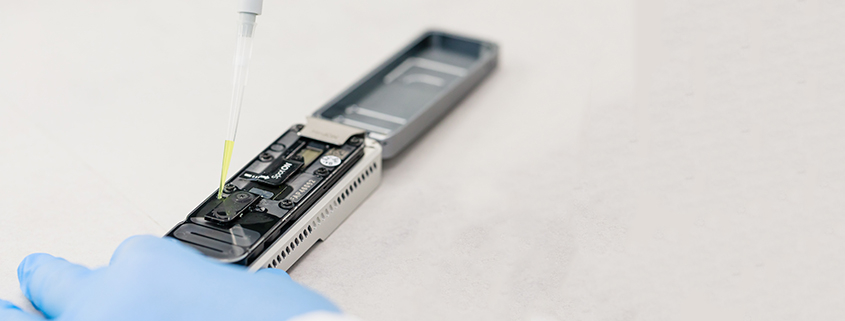
Dr. Carolin Dippmann and Daria Meyer from our research and development team work, among other things, with the “third-generation sequencing” method. With the help of this technology, they are examining DNA (deoxyribonucleic acid) from tumors much more precisely than was previously possible.

The method has enormous advantages: epigenetic changes in the DNA, specifically DNA methylation in certain regions, tell us when healthy cells develop into cancer. And with “third generation sequencing” we can detect these changes directly.

Our goal at oncgnostics is to detect such epigenetic markers. Especially in the early detection of head and neck tumors, development is still in its infancy. In various research projects, including the OroCa-Graz study, we are working together with clinicians on a standardized screening to detect the associated diseases earlier and more reliably than before.

In the following, the two scientists explain to what extent third-generation sequencing is being used and what exactly is behind it.

How does Third Generation Sequencing work?

Part of our daily work is to screen DNA fragments for epigenetic changes, specifically DNA methylation. DNA methylation at specific base sequences indicates that the cell in question has changed.

Third generation sequencing is a method that makes these analyses faster and more effective. In addition, the method provides the DNA sequence information in very high resolution: namely, individual DNA molecules are analyzed. The biological DNA is transferred into a digital version and can be analyzed on the computer. DNA methylation, which occurs during cancer development, can be analyzed directly. And this is of particular interest to us.

The process is illustrated in a video from “Oxford Nanopore Technologies” on YouTube.

How does the method differ from previous methods?

With previous sequencing methods, we could only determine the base sequence of short DNA fragments (300 DNA bases on average). In addition, the DNA to be examined had to be copied several times in advance, very similar to the so-called PCR method explained here. In addition, the DNA had to be chemically treated to detect DNA methylation.

The Third Generation Sequencing method simplifies this process:

  • We can directly evaluate DNA molecules of up to several million DNA bases in length
  • No copies are necessary for this. Rather, we evaluate the individual DNA sequences directly
  • The speed with which we examine the sequences increases accordingly: We now collect the data in real time

What kind of data do we get?

The bottom line is that the Third Generation Sequencing method captures changes in current and records them digitally. It works like this: The DNA to be examined is placed on a surface that is under a specific voltage. Tiny pores made of proteins are embedded in this surface. During the process, the DNA migrates, always in the same direction, through these so-called nanopores. This is why the method is also called “Oxford Nanopore Technology” (ONT).

When the DNA migrates through a pore, the current intensity on the surface changes. This is due to the spatial arrangement and chemical properties of the DNA segments. Sensors measure these changes at each individual pore and transmit them to the computer connected to each. An algorithm then translates the information into the base sequence of the DNA. In the sequence recorded we also read the DNA methylation.

Are there any other advantages or disadvantages?

Since the method is still very new, it has a fairly high error rate. Currently, it recognizes only 95 percent of all sequences without errors. With other methods, the figure is 99.9 percent. Continuous developments will improve this over time. Daria Meyer’s work is part of this. She is a bioinformatician and, as part of her PhD thesis, she focuses on improving the algorithms that are essential for analyzing DNA methylation. In addition, we are constantly optimizing the process flows in the preparation of diagnostic samples. That is Carolin Dippmann’s focus in the project.

In fact, the advantages outweigh the disadvantages. One of the reasons for this is that the analyzer is barely larger than a USB stick and therefore super handy. Theoretically, sequencing can be carried out anywhere, from the Arctic to the desert.

What is our future benefit from Third Generation Sequencing?

With the help of ONT sequencing, major gaps in our knowledge of the human genome (the entire DNA sequence of a human being) have already been closed. We expect further developments in this area. And we are happy contribute to improving the technology.

The biggest advantage for us is the direct readability of epigenetic changes, i.e. DNA methylation. We can analyze these directly at our facility.

The method is gaining acceptance in more and more areas of application. This is not least due to the fact that the initial equipment for starting sequencing projects is very inexpensive. Sequencing of this quality is thus much more affordable. This means that small companies like oncgnostics can also utilize this technology.

31. January 2022/by TowerPR
https://www.epitype.de/wp-content/uploads/2022/01/220110_Third_Generation_Sequencing.jpg 321 845 TowerPR https://www.epitype.de/wp-content/uploads/2025/09/epitype_website-logo-300x130.png TowerPR2022-01-31 10:41:062022-01-31 10:41:06Third Generation Sequencing: Detecting cancer at DNA level

Archive

Recent Posts

  • Worldwide unique test for cervical cancer as a gamechanger for the healthcare system
  • Jena Biotechnology Company Files for Insolvency
  • Bachelor thesis in biotechnology companies: From research to diagnostics 

Epitype GmbH

The Epitype GmbH, a spin-off of the University Hospital Jena, is a company working on molecular diagnostics with main focus on the development of in-vitro diagnostics based on epigenetic biomarkers.

Epitype GmbH is working according to ISO 13485 standards in research, development, production and management.

Recent Posts

  • Worldwide unique test for cervical cancer as a gamechanger for the healthcare system
  • Jena Biotechnology Company Files for Insolvency
  • Bachelor thesis in biotechnology companies: From research to diagnostics 

Contact

Epitype GmbH
Löbstedter Str. 41
07749 Jena
Germany

Phone: +49 (0)3641 5548500

Email: contact[at]epitype.de
Internet: www.epitype.de

© 2015 - 2025 Epitype GmbH Jena Germany
  • Start
  • Imprint
  • Contact Us
  • Privacy policy
Scroll to top

Cookies help us deliver our services. By using our services, you agree to our use of cookies.

Learn moreI accept

Cookie and Privacy Settings


How we use cookies

We may request cookies to be set on your device. We use cookies to let us know when you visit our websites, how you interact with us, to enrich your user experience, and to customize your relationship with our website.

Click on the different category headings to find out more. You can also change some of your preferences. Note that blocking some types of cookies may impact your experience on our websites and the services we are able to offer.

Essential Website Cookies

These cookies are strictly necessary to provide you with services available through our website and to use some of its features.

Because these cookies are strictly necessary to deliver the website, refusing them will have impact how our site functions. You always can block or delete cookies by changing your browser settings and force blocking all cookies on this website. But this will always prompt you to accept/refuse cookies when revisiting our site.

We fully respect if you want to refuse cookies but to avoid asking you again and again kindly allow us to store a cookie for that. You are free to opt out any time or opt in for other cookies to get a better experience. If you refuse cookies we will remove all set cookies in our domain.

We provide you with a list of stored cookies on your computer in our domain so you can check what we stored. Due to security reasons we are not able to show or modify cookies from other domains. You can check these in your browser security settings.

Other external services

We also use different external services like Google Webfonts, Google Maps, and external Video providers. Since these providers may collect personal data like your IP address we allow you to block them here. Please be aware that this might heavily reduce the functionality and appearance of our site. Changes will take effect once you reload the page.

Google Webfont Settings:

Google Map Settings:

Google reCaptcha Settings:

Vimeo and Youtube video embeds:

Privacy Policy

You can read about our cookies and privacy settings in detail on our Privacy Policy Page.

Privacy policy
Einstellungen akzeptierenVerberge nur die Benachrichtigung
Epitype GmbH
Einwilligung verwalten

Um Ihnen ein optimales Erlebnis zu bieten, verwenden wir Technologien wie Cookies, um Geräteinformationen zu speichern und/oder darauf zuzugreifen. Wenn Sie diesen Technologien zustimmen, können wir Daten wie das Surfverhalten oder eindeutige IDs auf dieser Website verarbeiten. Wenn Sie Ihre Einwilligung nicht erteilen oder zurückziehen, können bestimmte Merkmale und Funktionen beeinträchtigt werden.

Funktional Always active
Die technische Speicherung oder der Zugang ist unbedingt erforderlich für den rechtmäßigen Zweck, die Nutzung eines bestimmten Dienstes zu ermöglichen, der vom Teilnehmer oder Nutzer ausdrücklich gewünscht wird, oder für den alleinigen Zweck, die Übertragung einer Nachricht über ein elektronisches Kommunikationsnetz durchzuführen.
Präferenzen
Die technische Speicherung oder der Zugriff ist für den rechtmäßigen Zweck der Speicherung von Präferenzen erforderlich, die nicht vom Abonnenten oder Benutzer angefordert wurden.
Statistiken
Die technische Speicherung oder der Zugriff, der ausschließlich zu statistischen Zwecken erfolgt. Die technische Speicherung oder der Zugriff, der ausschließlich zu anonymen statistischen Zwecken verwendet wird. Ohne eine Vorladung, die freiwillige Zustimmung deines Internetdienstanbieters oder zusätzliche Aufzeichnungen von Dritten können die zu diesem Zweck gespeicherten oder abgerufenen Informationen allein in der Regel nicht dazu verwendet werden, dich zu identifizieren.
Marketing
Die technische Speicherung oder der Zugriff ist erforderlich, um Nutzerprofile zu erstellen, um Werbung zu versenden oder um den Nutzer auf einer Website oder über mehrere Websites hinweg zu ähnlichen Marketingzwecken zu verfolgen.
  • Manage options
  • Manage services
  • Manage {vendor_count} vendors
  • Read more about these purposes
Einstellungen ansehen
  • {title}
  • {title}
  • {title}